Tracking Earthquakes and Volcanoes using Google Earth |
||
Tracking Earthquakes 1.
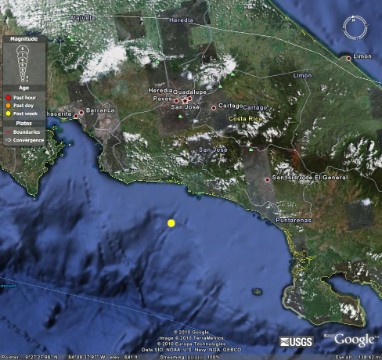
Magnitude = 4.9 Earthquake Location = Baja California, Mexico Date = Saturday, May 22, 2010 Time = 10:30:57 AM at Epicenter Depth Below Surface = 5.4 Kilometers (3.36 Miles) Type of Plate Boundary = Continental-Continental Transform Boundary 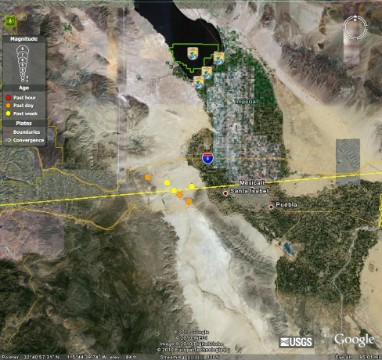 2. Magnitude = 5.9 Earthquake Location = South Coast of Costa Rica Date = Thursday, May 20, 2010 Time = 4:16:30 PM at Epicenter Depth Below Surface = 21 Kilometers (13.05 Miles) Type of Plate Boundary = Oceanic-Continental Convergent Boundary with a Subduction Zone
 3. Magnitude = 6.0 Earthquake Location = Northern Peru Date = Wednesday, May 19, 2010 Time = 11:15:44 PM at Epicenter Depth Below Surface = 138.20 Kilometers (85.87 Miles) Type of Plate Boundary = Oceanic-Continental Convergent Boundary 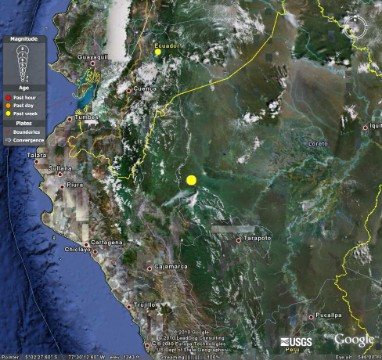 4. Magnitude = 5.3 Earthquake Location = Ocean South of Africa Date = Sunday, May 16, 2010 Time = 3:08:07 AM at Epicenter Depth Below Surface = 10 Kilometers (6.21 Miles) Type of Plate Boundary = Ocean-Oceanic Transform Boundary (Also really close to a Oceanic-Oceanic Divergent Boundary) 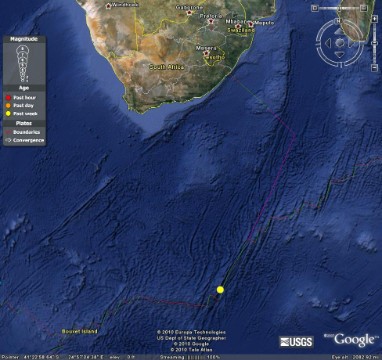 5. Magnitude = 5.3 Earthquake Location = Kuril Islands (next to Japan) Date = Tuesday, May 18, 2010 Time = 10:03:45 AM at Epicenter Depth Below Surface = 54 Kilometers (33.55 Miles) Type of Plate Boundary = Subduction Zone, near a Oceanic-Continental Convergent 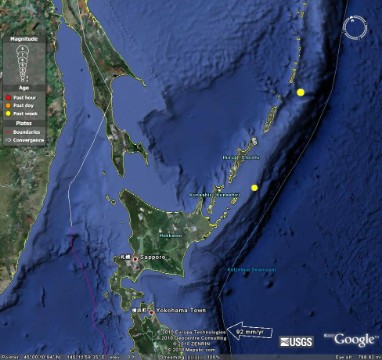 |
Tracking Volcanoes 1. Where = Bald Knoll Volcano in Southern Utah, USA Type = Cinder-Cone Volcano Type of Plate Boundary = Continental-Continental Divergent Boundary 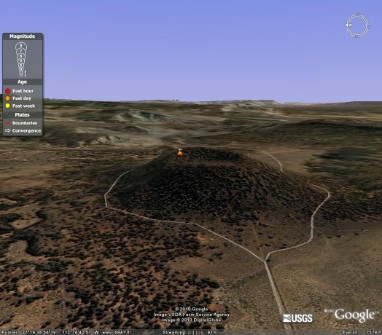 2. Where = Glacier Peak Volcano in Northern Washington, USA Type = Composite Volcano Type of Plate Boundary = Oceanic-Continental Convergent Boundary forcing a subduction zone. 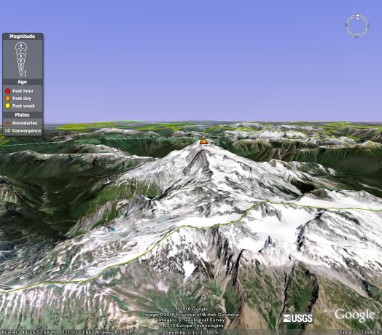 3. Where = Hell’s Half Acre in Southern Idaho, USA Type = Shield Volcano Type of Plate Boundary = Continental-Continental Divergent Boundary 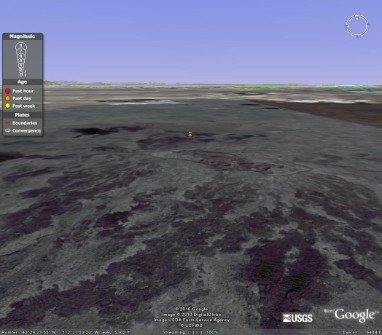 4. Where = Yellowstone in Wyoming, USA Type = Hot Spot and Caldera Volcano Type of Plate Boundary = Continental-Continental Divergent Boundary. 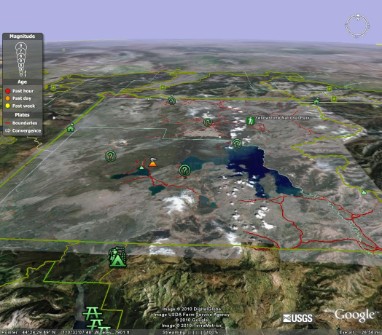 1. While tectonic plate move around the earth the destroying and creating of new plates is what cause earthquakes and volcanoes. On the Mid-Atlantic Ridge the Earth is Stretching by pushing the American continents and the Africa with Europe and Asia continents apart. This happens by volcanic activity creating new sea floor. On the other side of the earth the Pacific Ocean the plate tectonics are doing the opposite. The earth is destroying tectonic plates by forcing them called Subduction into the mantel of the earth. No body knows if the Atlantic side is pushing or if the Pacific side is pulling. Around these areas of Subduction the earth will create volcanoes and earthquakes. As tectonic plates move and build up pressure they release as an earthquake. A fault line on the tectonic plate has shifted a bit. When Subduction has taken place that plate that is receding into earth will reach far enough under the earth’s mantle the rock has started to melt and it rises to the surface as volcanoes. 2. The relationship these natural forces will cause earthquakes and volcanoes. When two continents are separating called divergence it will force other continents to collide call convergence. Divergence and convergence can happen on land as a continental form or the ocean as oceanic form, oceanic and Continental can happen to each other also. While certain plate separate to create new ocean floor or continental land it will cause a plate to be diverted under the earths surface into the mantle and core of the earth to be recycled as new rock and eventually re-surface possibly as a new land continent. 3. I did not know that earthquakes and volcanoes were interconnected. I knew that earthquakes were source by plates releasing energy. However, I did not know that volcanoes were caused by diverging plate tectonics subducting. I did not know that the subducting plate would cause the overlapping plate to bulge up into mountains and volcanoes. I learned the different types of fault lines that are in relation to the different type of plate tectonic boundaries. |
|
